Video Demonstrations
Demo 1: Designed Co-Speech Actions
Demo 2: A Glance of CLIO guided tours
Problem Statement and Our Solution
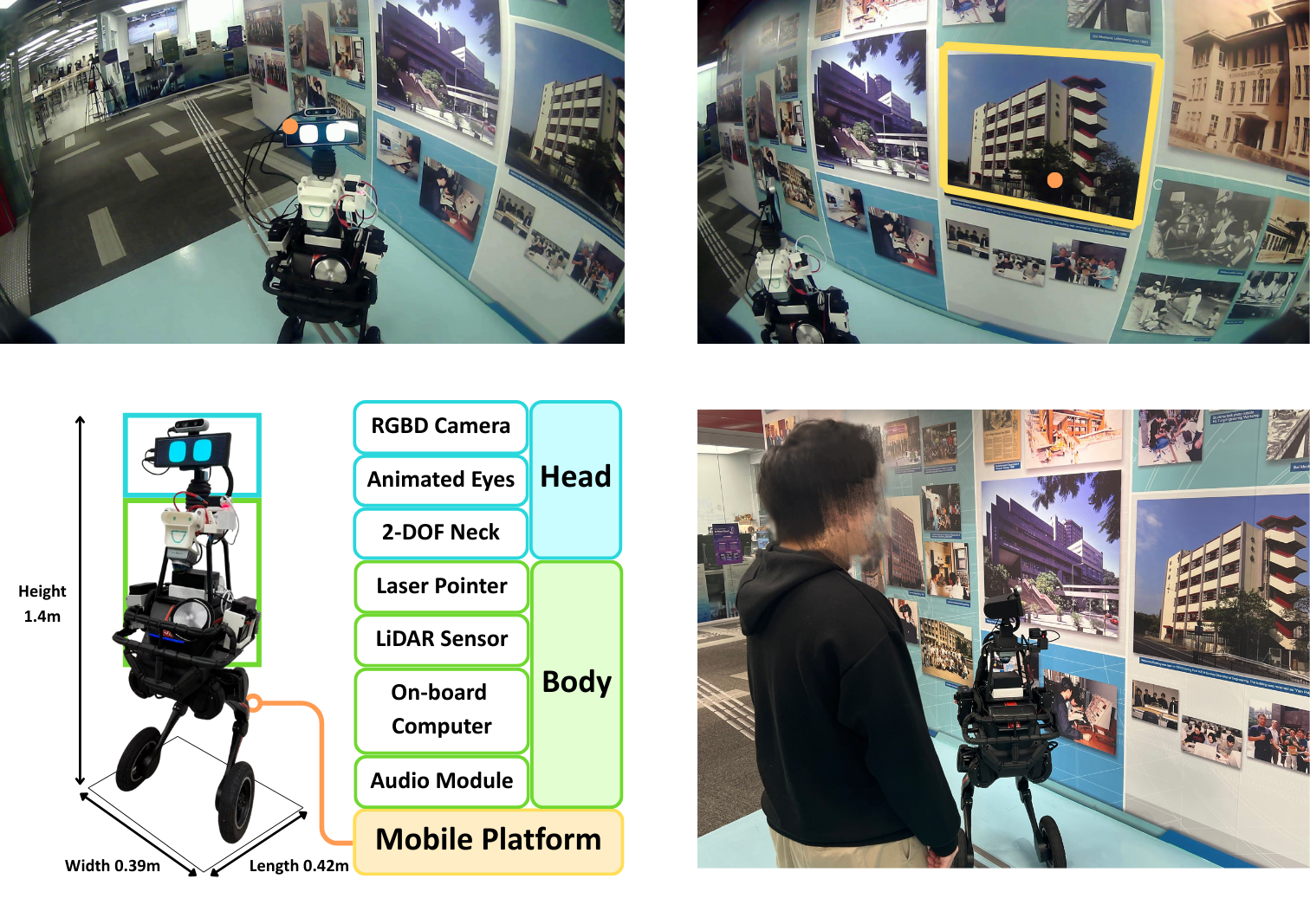
Problem Statement While audio guides provide extensive information, it is often hard for visitors to establish connection between specific exhibit details and the verbal descriptions. In contrast, human docents establish eye contact and point directly to specific regions while providing contextual explanations.
We present a robotic tour guide, CLIO, named after the muse of history in Greek mythology. It carries a display as its head and a laser pointer to orient visitors' attention by its head movement and laser pointer. Animated eyes are displayed to build eye contact. An optional low-code interface based on a Large Language Model is offered to coordinate the designed actions with a given narrative script for exhibition.
Hypotheses to Validate the Designed Co-speech Actions
H1: The designed co-speech actions can guide visitors' visual attention in a real-world exhibition set-up.
H2: Tours with designed actions can enhance the visitor's engagement during the tour.
H3: The (arm-less) robotic system with co-speech actions is perceived as natural and intuitive in a tour guide context.
Experiment Setup
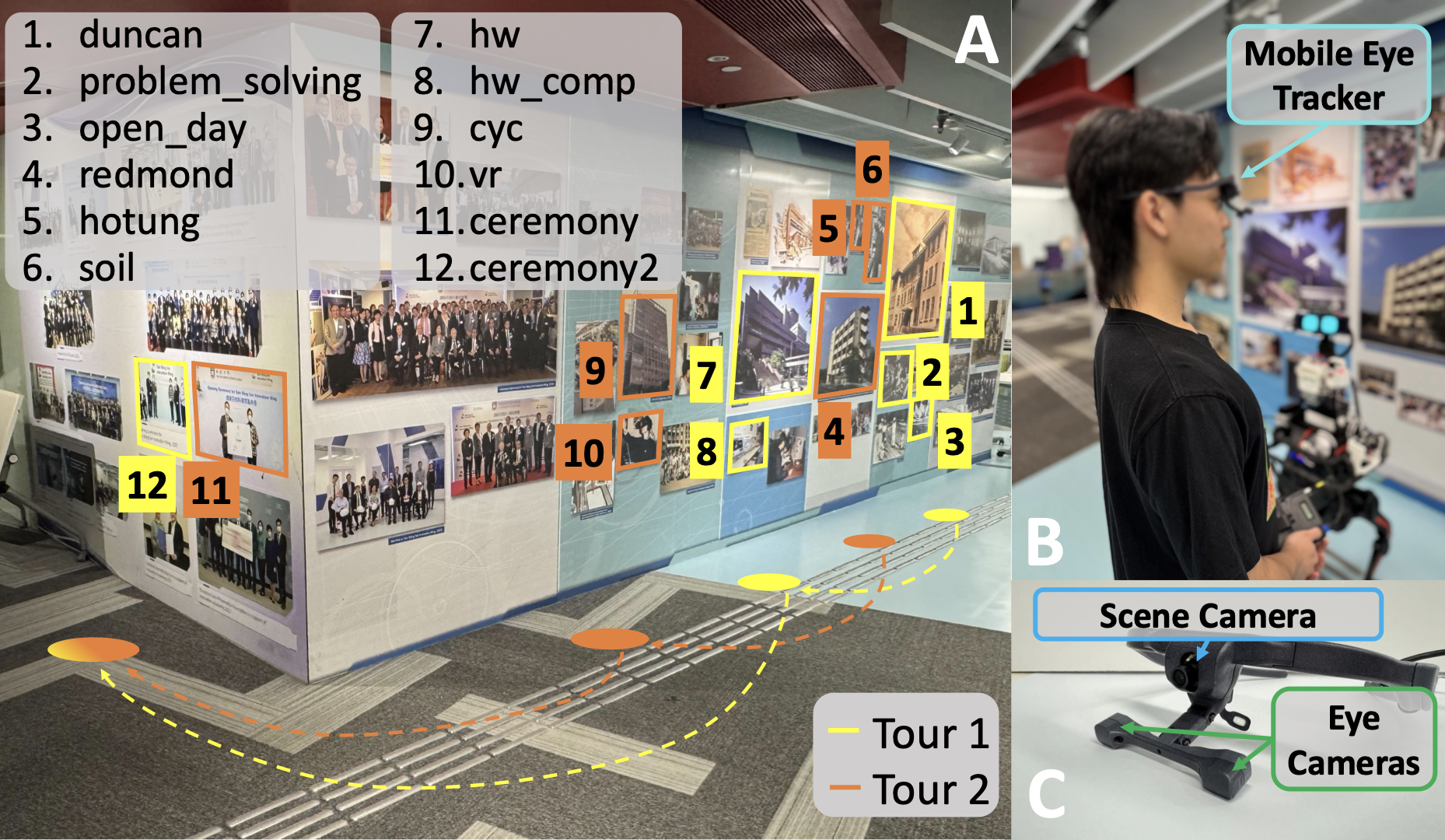
Experiment Setup. Given two conditions, Audio-only baseline and CLIO with co-speech actions, we conducted a user study in a mock-up exhibition of historical photographs. Each participant experienced both conditions in a within-subject design. To avoid familiarity effects, we designed two different routes with different sets of photographs for the two conditions. (A) shows the two slightly different routes. (B) shows a participant experiencing the tour with CLIO. We collected eye gaze data via a mobile eye tracker, shown in (C), during the tour to provide quantitative measurements in addition to the qualitative feedback.
Quantitative Analysis through Eye Tracking Data
We compared eye tracking data between the Audio-only baseline and CLIO with co-speech actions. This comparison exemplifies that the participant's gaze at the CLIO condition better aligned with the mentioned exhibits than that at the Audio-only condition.
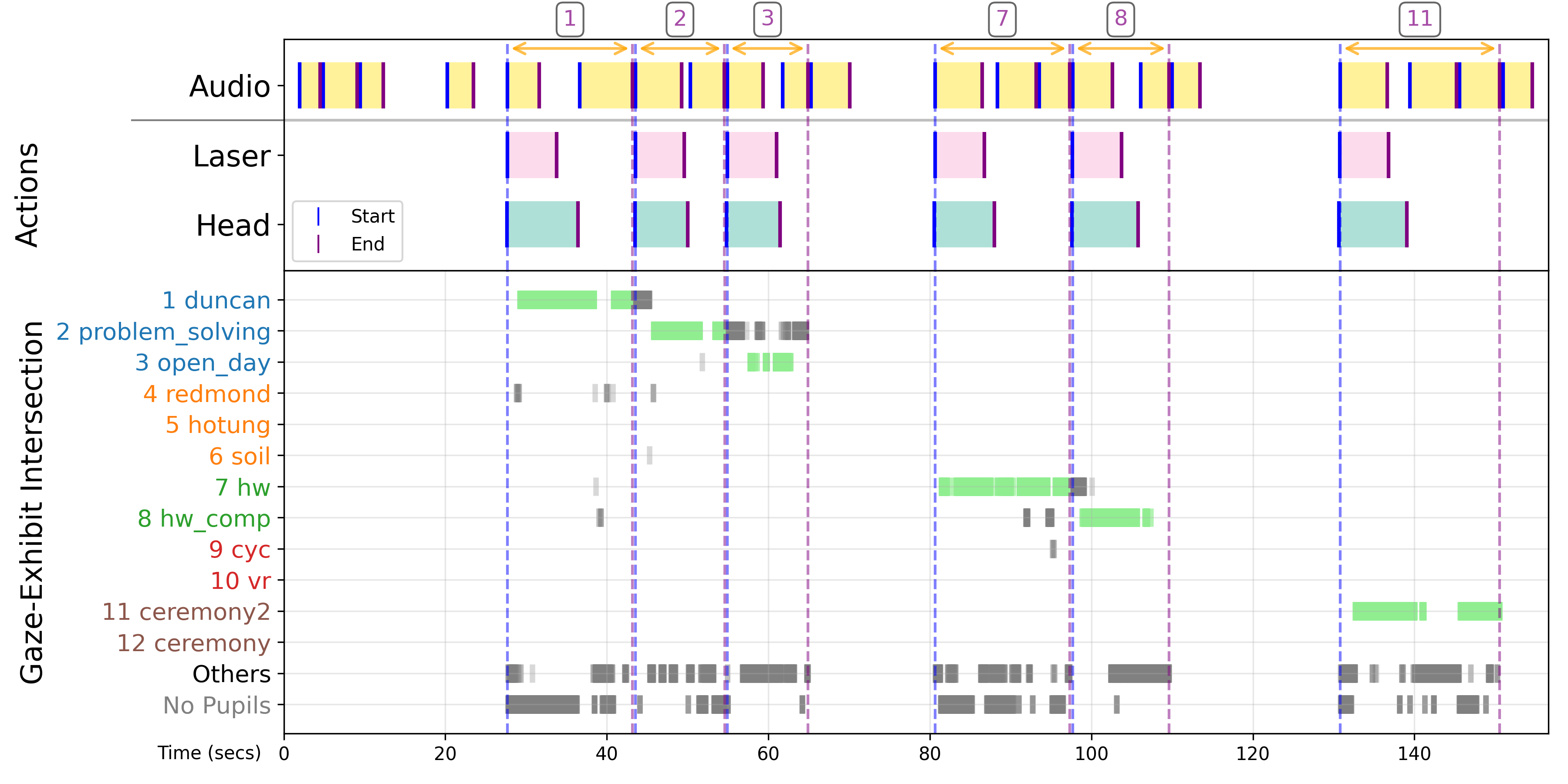
CLIO with co-speech actions
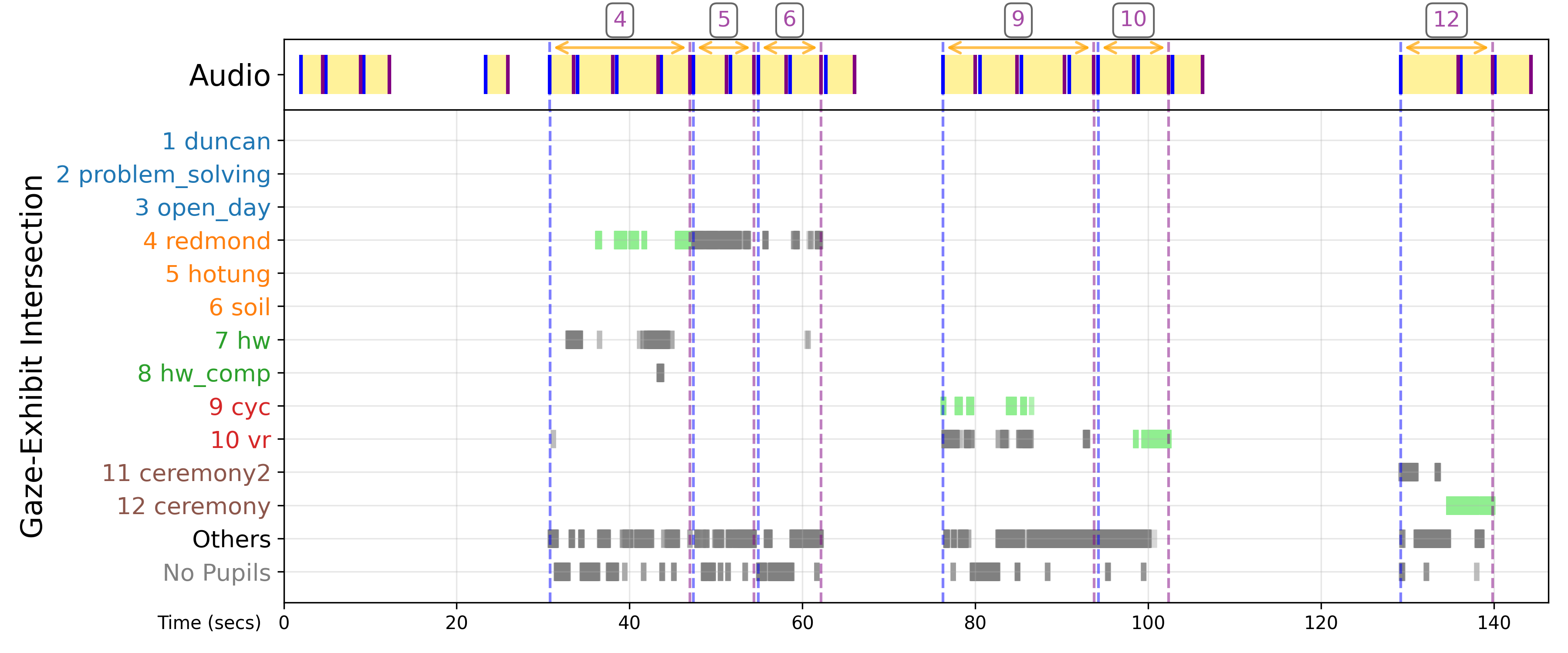
Audio-only baseline
The upper block shows the robot actions and the lower block shows the participant's gaze data over time. The lower row block shows where the participant gazed during the tour. If the gaze coincided with the exhibit being mentioned, green color markers are used. Otherwise, the gaze at a timestamp is shown in grey. Numbered items in this lower block are the exhibits. Others indicate no intersection between the gaze and any of the exhibits; and No pupils indicate the eye gaze could not be computed by the mobile eye tracker. Vertical dashed lines in blue and red respectively mark the start and end of the narration regarding an exhibit.
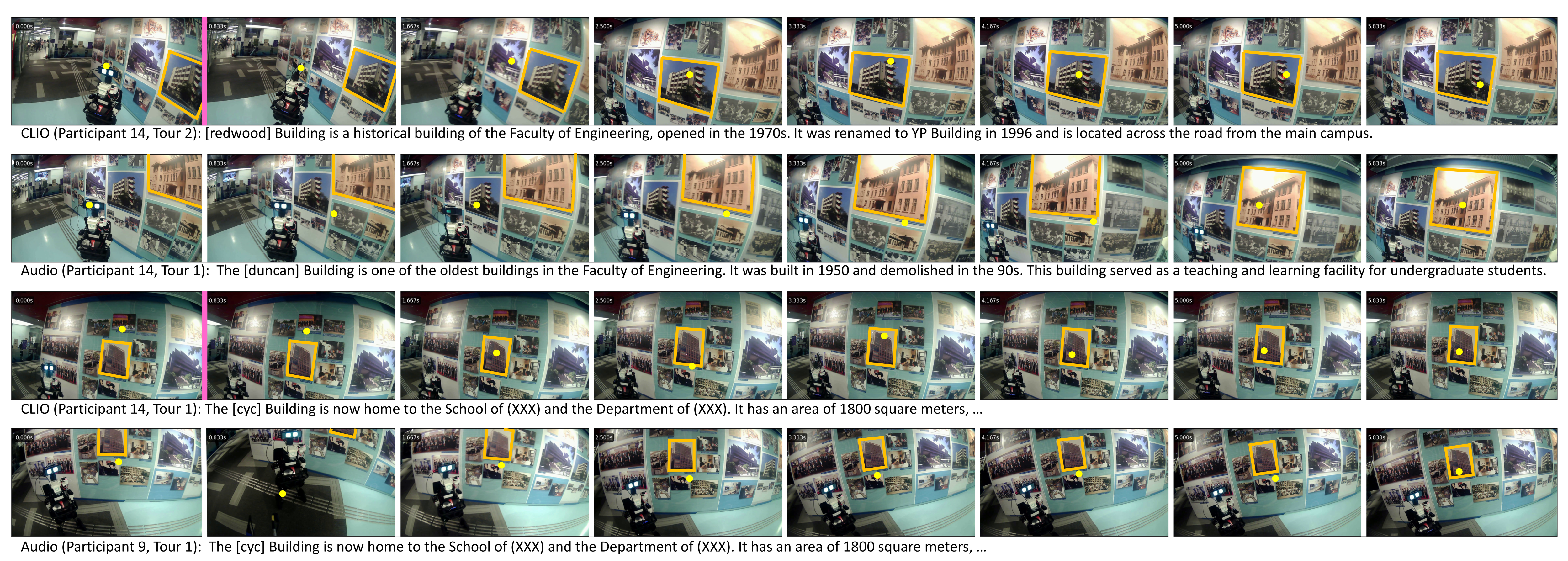
Visual comparison of the eye tracking data. This visual comparison showcases how the visual attention of a participant is guided by CLIO's co-speech actions compared to the Audio-only baseline. Participant 14 at different conditions (and thus different tours) is illustrated at the top two rows. Participants 14 and 9 at the same section of the exhibition are illustrated at the bottom two rows, one at the CLIO condition and the other at the Audio-only condition.
Qualitative Results
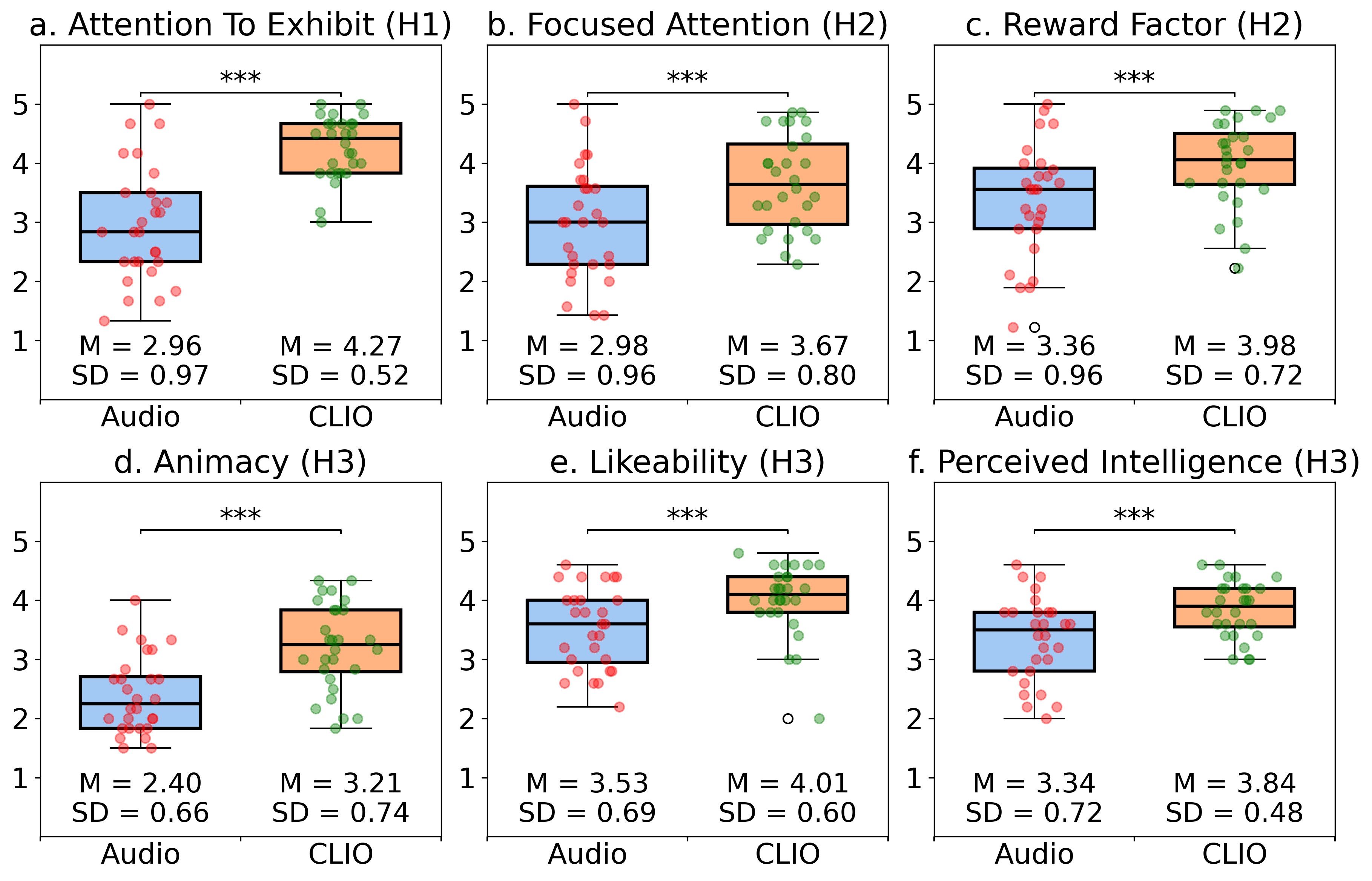
Analysis of the Questionnaire Feedback. (a) is designed to validate H1 regarding the effectiveness of visual attention guidance. A self-developed questionnaire is used. (b) and (c) are adopted from User Engagement Scale (Long form) to measure Focused Attention and Reward Factor, demonstrating the engagement level. Subfigures (d-f) are adopted from Godspeed Questionnaire Series to measure Animacy, Likeability, and Perceived Intelligence. 5-point Likert scales are used in all questionnaires. In all scales, we observed statistically significant improvements (p<0.001) in the CLIO condition compared to the Audio-only baseline, supporting our hypotheses.
More Video Demos
A Full Tour by CLIO
HKU Info Day on October 25, 2025
Citation
            @inproceedings{clio2026,
            title={CLIO: Coordinate User Visual Attention with Audio Narratives for Enhanced Engagement},
            author={Chen, Yuxuan and Lo, Ian Leong Ting and Guo, Bao and Kawmali, Netitorn and Chan, Chun Kit and Wang, Ruoyu and Pan, Jia and Yang, Lei},
            booktitle={Companion Proceedings of the 21st ACM/IEEE International Conference on Human-Robot Interaction},
            series={HRI Companion '26},
            year={2026},
            month={March},
            address={Edinburgh, Scotland, UK},
            publisher={ACM},
            doi={10.1145/3776734.3794565}
            }
Contact
For questions or collaboration opportunities, please contact us at: lyang125@hku.hk
Acknowledgement
This work is supported by Tam Wing Fan Innovation Fund and Philomathia Foundation Innovation Fund.